Maria Rye
Our Western Home
FOR INFORMATION ON THE MARIA RYE CHILDREN PLEASE CONTACT
MARIA RYE HOME CHILDREN DATABASE
NIAGARA-ON-THE-LAKE MUSEUM DATABASE
COMPILED BY DAVID HEMMINGS
HTTPS://WWW.NOTLMUSEUM.CA/RESEARCH/BRITISH-HOME-CHILDREN
MARIA RYE HOME CHILDREN DATABASE
NIAGARA-ON-THE-LAKE MUSEUM DATABASE
COMPILED BY DAVID HEMMINGS
HTTPS://WWW.NOTLMUSEUM.CA/RESEARCH/BRITISH-HOME-CHILDREN
This database contains information on 5,300 British Home Children (BHCs) who were administered by Our Western Home in Niagara-on-the-Lake (NOTL), Ontario between 1868 and 1914.
In addition to the database for these 5,300 Home Children, there is also the first large, consolidated database of the Life Events of 1,200 married BHCs after they arrived in Canada. Much of this research came from the Ancestry database, which has been established with family history submissions by relations of these BHCs, supported by ship manifest, census, BMD, emigration, etc. records.
In addition to the database for these 5,300 Home Children, there is also the first large, consolidated database of the Life Events of 1,200 married BHCs after they arrived in Canada. Much of this research came from the Ancestry database, which has been established with family history submissions by relations of these BHCs, supported by ship manifest, census, BMD, emigration, etc. records.
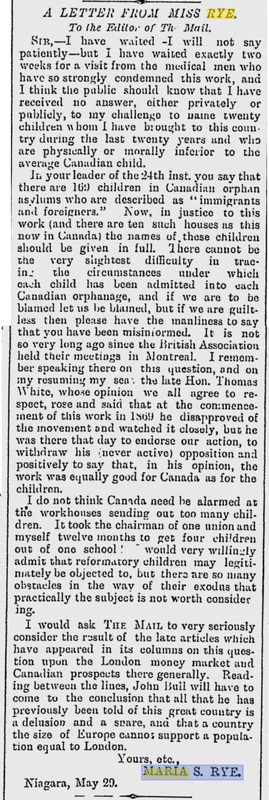
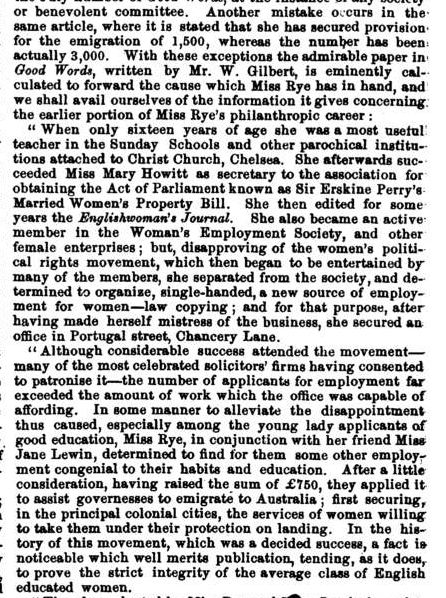
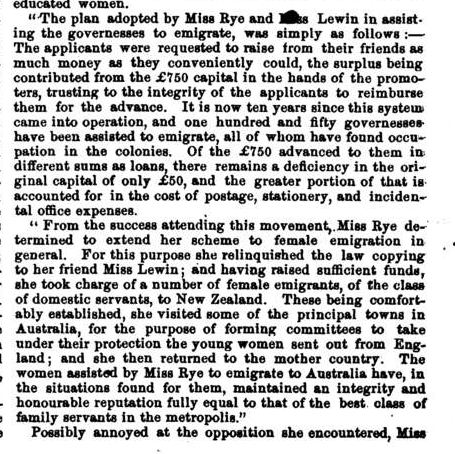
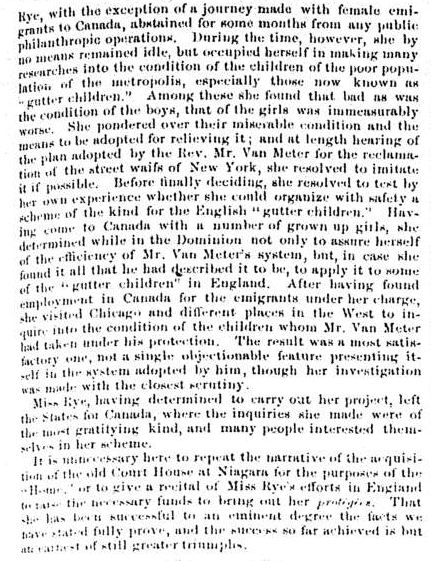
Article from the Toronto Daily Mail 1888
|
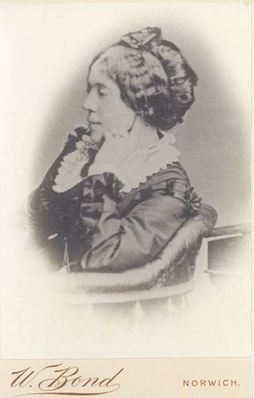
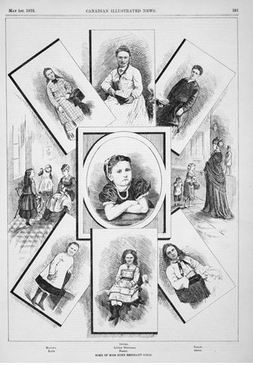
Some of the Maria Rye children
|
Eliza Morris
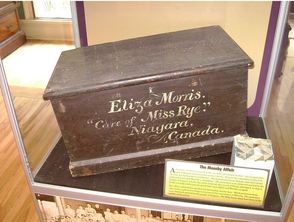
This trunk, currently on display at the Niagara Historical Society & Museum at Niagara-on-the-Lake possibly belonged to an Eliza Morris who arrived in Canada aboard the Sarmatian with the Maria Rye party on 12 May 1873. Eliza was a thirteen year old orphan from the Merthyr Tydfil Union in Wales. A 1875 Inspection Report states: Woodstock Centre, Frank Ball, Inspector (Francis R Ball, Barrister), Eliza Morris, Merthyr Workhouse 1873, with John Bowles, Ingersoll. (Oxford County).
There is a death record record for an Eliza Morris who died September 4 1889 at the age of 28 years in Wentworth Hamilton. She was born in England in about 1861.
photo courtesy of Scott Baltjes
Scott Baltjes Books
More information on the Maria Rye children:
Susan Jane Robinson - A Maria Rye Home Child
There is a death record record for an Eliza Morris who died September 4 1889 at the age of 28 years in Wentworth Hamilton. She was born in England in about 1861.
photo courtesy of Scott Baltjes
Scott Baltjes Books
More information on the Maria Rye children:
Susan Jane Robinson - A Maria Rye Home Child
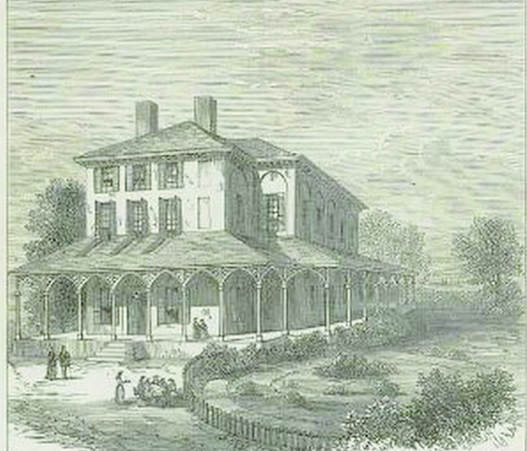
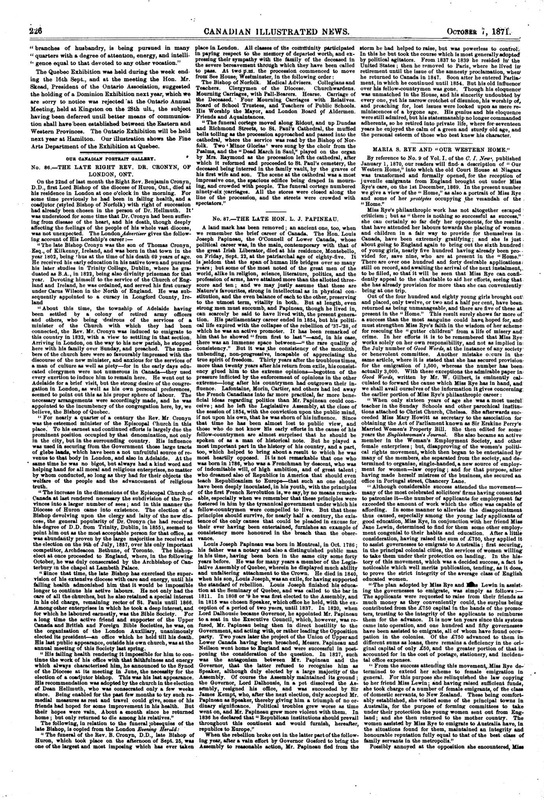
1877 Maria Rye Our Western Home
The History of Our Western Home - Maria Rye
as prepared for the BHCARA Canada 150 Magazine by Lori Oschefski
edited by Ann Griffin
During the War of 1812, on the morning of October 13th, Fort George and the Village of Niagara, as Niagara-on-the-Lake was then named, came under heavy enemy fire. Within minutes, the Court House and Gaol, along with fifteen homes, were set ablaze and destroyed. Adding to the enormity of the loss, some 300 prisoners perished in the jail when it was burned. At the close of the War of 1812-14, the Village of Niagara lay in ruins.
An advertisement published in 1816 in the St. Davids Spectator, for brick, stone, lumber, lath, shingles and such, for a jail and court house, was signed by Ralfe Clench, a United Empire Loyalist, a member of Butler's Ranger, a member of Parliament, a Judge and a veteran. Mr. Clench, remarkably, had signed the advertisement for materials for the first jail and court house in Niagara in 1795.
Officials made the decision to move the town further inland, away from the river and American territory on the opposite shore. The new Court House and Jail, built in 1817, were constructed well away from the previous town centre. This building of stately red brick with a lavish woodwork interior, became known as the most splendid and handsome building in Upper Canada.
The jail cells were located on the main floor. They were open to the hall which led to the Court room, so the inmates were exposed to the gaze of those who entered. The partitions were of bolted oak, and the nine-inch thick doors were two thickness of wood with sheet iron in between. Some of the cells were heated with wood fireplaces, but inmates in stoveless cells could only gaze out at the stove in the hallway, which offered them no warmth during the Canadian winters.
One the most notable historical and dramatic events which happened in this building, was the 1837 Slave Escape. At that time, there were three hundred to four hundred inhabitants of Niagara who had escaped slavery from the United States. One of these men, named Mosby, had used his master’s horse to escape. Following him to Canada, his master had him arrested and demanded he be returned to the States. Hundreds of excited people of both races gathered by the jail to ensure Mosby was not removed. The protest continued for two weeks until a wagon arrived to transport Mosby back to the USA. A riot ensued, including women armed with stones in stockings. Determined protestors stuck rails from a fence into the wagon’s wheels, and Mosby escaped. Gunshots were fired, two men died.
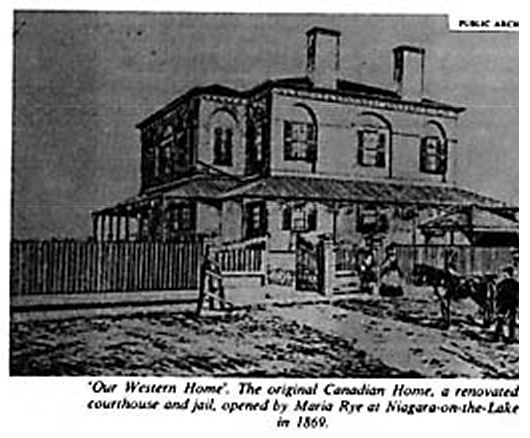
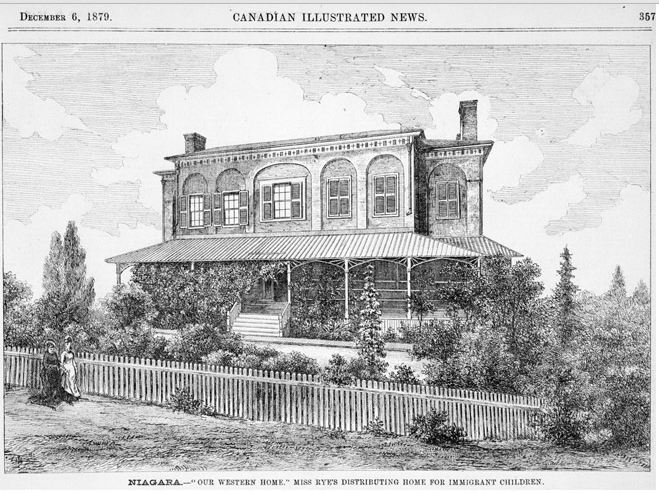
The building served as a double purpose jail and court house from 1817 until 1847. From 1847 until 1866 it was a jail only. The building sat empty from 1866 until 1869, when Maria Rye purchased it and refurbished it as a home to receive British children. The spectator's gallery and the fine arches remained, but the prisoners’ cells were removed. One grating remained, only about a foot square, from which a prisoner condemned to death might take his last sight of the light of day. Rye had trees and flowers planted outside the building.
Our Western Home officially opened on December 1st, 1869, with many dignitaries present, including the Mayor of Niagara, Mr. Tibbert Ball, the magistrate of the county; Judge Lauder, of St. Catherine's Ontario; Rev. Dr. Macmurray, Rector of Niagara, Rev. Mr. Burchall, rector of the Presbyterian Church at St. Catherine's; Rev. Mr. Holland, clergyman of the Church of England and many others. It opened with a prayer and afterwards the children were introduced to the visitors.
Some 4,000 children came to Canada through Maria Rye. She retired in 1895, and returned to England, turning her home and work over to the Church of England Waifs and Strays Society, which had initially brought their first children to Canada through Maria Rye The Church of England used Our Western Home to receive their girls from 1895 until 1914 when the home was sold and demolished. Maria Rye died in 1903 at the age of 74. The street leading to the land where the building stood is now called Rye Street, and a plaque marks the spot where the home used to be. From rebels, debtors, escaped slaves, public executions and the British Home Children who were placed through these walls, this building shaped Ontario’s history.
An advertisement published in 1816 in the St. Davids Spectator, for brick, stone, lumber, lath, shingles and such, for a jail and court house, was signed by Ralfe Clench, a United Empire Loyalist, a member of Butler's Ranger, a member of Parliament, a Judge and a veteran. Mr. Clench, remarkably, had signed the advertisement for materials for the first jail and court house in Niagara in 1795.
Officials made the decision to move the town further inland, away from the river and American territory on the opposite shore. The new Court House and Jail, built in 1817, were constructed well away from the previous town centre. This building of stately red brick with a lavish woodwork interior, became known as the most splendid and handsome building in Upper Canada.
The jail cells were located on the main floor. They were open to the hall which led to the Court room, so the inmates were exposed to the gaze of those who entered. The partitions were of bolted oak, and the nine-inch thick doors were two thickness of wood with sheet iron in between. Some of the cells were heated with wood fireplaces, but inmates in stoveless cells could only gaze out at the stove in the hallway, which offered them no warmth during the Canadian winters.
One the most notable historical and dramatic events which happened in this building, was the 1837 Slave Escape. At that time, there were three hundred to four hundred inhabitants of Niagara who had escaped slavery from the United States. One of these men, named Mosby, had used his master’s horse to escape. Following him to Canada, his master had him arrested and demanded he be returned to the States. Hundreds of excited people of both races gathered by the jail to ensure Mosby was not removed. The protest continued for two weeks until a wagon arrived to transport Mosby back to the USA. A riot ensued, including women armed with stones in stockings. Determined protestors stuck rails from a fence into the wagon’s wheels, and Mosby escaped. Gunshots were fired, two men died.
The building served as a double purpose jail and court house from 1817 until 1847. From 1847 until 1866 it was a jail only. The building sat empty from 1866 until 1869, when Maria Rye purchased it and refurbished it as a home to receive British children. The spectator's gallery and the fine arches remained, but the prisoners’ cells were removed. One grating remained, only about a foot square, from which a prisoner condemned to death might take his last sight of the light of day. Rye had trees and flowers planted outside the building.
Our Western Home officially opened on December 1st, 1869, with many dignitaries present, including the Mayor of Niagara, Mr. Tibbert Ball, the magistrate of the county; Judge Lauder, of St. Catherine's Ontario; Rev. Dr. Macmurray, Rector of Niagara, Rev. Mr. Burchall, rector of the Presbyterian Church at St. Catherine's; Rev. Mr. Holland, clergyman of the Church of England and many others. It opened with a prayer and afterwards the children were introduced to the visitors.
Some 4,000 children came to Canada through Maria Rye. She retired in 1895, and returned to England, turning her home and work over to the Church of England Waifs and Strays Society, which had initially brought their first children to Canada through Maria Rye The Church of England used Our Western Home to receive their girls from 1895 until 1914 when the home was sold and demolished. Maria Rye died in 1903 at the age of 74. The street leading to the land where the building stood is now called Rye Street, and a plaque marks the spot where the home used to be. From rebels, debtors, escaped slaves, public executions and the British Home Children who were placed through these walls, this building shaped Ontario’s history.
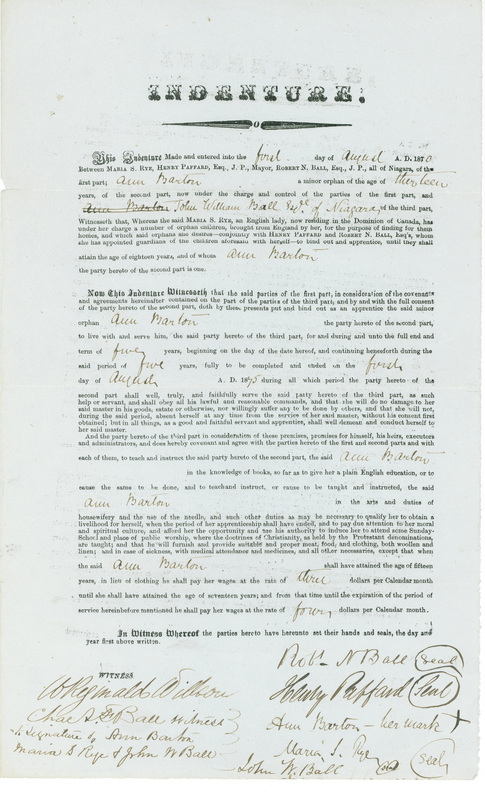
Rules for Acquiring an Orphan from Miss Rye
OUR WESTERN HOME - Niagara, Ont.,
The children vary in age from 3 to 13 years; are all Protestants, and nearly all absolute Orphans; are bound (when not adopted) till they are 18 years old, on the following terms, viz: Up to 15 years old they are to be fed, clothed and sent to Sunday School. From 15 to 17 they are not clothed, but paid $3 a month wages, and $4 a month from 17 to 18.
If through any unforseen circumstances, it is necessary for a child to be returned to the Home, due notice of the same must be given in writing, one month before the child is removed; and if the child has been away from the Home six months, her clothes must be returned new and whole, and in the same number as they left the Home. In no case can a child be passed on to another family without first consulting Miss Rye, and in case of the death of persons (husband or wife) taking children, it is particularly requested that an immediate notice of the fact be sent to the Home.
Miss Rye reserves to herself the right of removing any child with whose treatment she is not satisfied
MARIA S RYE
Hon Secretary
N.B. Only children under nine years of age can be adopted.
OUR WESTERN HOME - Niagara, Ont.,
The children vary in age from 3 to 13 years; are all Protestants, and nearly all absolute Orphans; are bound (when not adopted) till they are 18 years old, on the following terms, viz: Up to 15 years old they are to be fed, clothed and sent to Sunday School. From 15 to 17 they are not clothed, but paid $3 a month wages, and $4 a month from 17 to 18.
If through any unforseen circumstances, it is necessary for a child to be returned to the Home, due notice of the same must be given in writing, one month before the child is removed; and if the child has been away from the Home six months, her clothes must be returned new and whole, and in the same number as they left the Home. In no case can a child be passed on to another family without first consulting Miss Rye, and in case of the death of persons (husband or wife) taking children, it is particularly requested that an immediate notice of the fact be sent to the Home.
Miss Rye reserves to herself the right of removing any child with whose treatment she is not satisfied
MARIA S RYE
Hon Secretary
N.B. Only children under nine years of age can be adopted.
Children mentioned in the above document:
Deaths:
Hugh Astin, 12 years old, killed by the kick of a horse at Mount Forest in 1872,
Edith Hutchins, aged 17, accidentally burned to death in the house of Mr. Rhind, Niagara June of 1873
Polly Thompson, aged 12, burned to death Feb 1874 in thee house of Mr. Adamson, of Hamilton.
Herbert Radley, aged 18 months of mesenteric disease in 1870
Elizabeth Schofield, 20, a dwarf, of typhoid fever in Feb 1871
Caroline Newbold, aged 14 of typhoid fever in August 1873
Ill treated:
Nancy Nye, Holborn,
Sarah Saxby, Peckham
Constance Branch, Lambeth
Deaths:
Hugh Astin, 12 years old, killed by the kick of a horse at Mount Forest in 1872,
Edith Hutchins, aged 17, accidentally burned to death in the house of Mr. Rhind, Niagara June of 1873
Polly Thompson, aged 12, burned to death Feb 1874 in thee house of Mr. Adamson, of Hamilton.
Herbert Radley, aged 18 months of mesenteric disease in 1870
Elizabeth Schofield, 20, a dwarf, of typhoid fever in Feb 1871
Caroline Newbold, aged 14 of typhoid fever in August 1873
Ill treated:
Nancy Nye, Holborn,
Sarah Saxby, Peckham
Constance Branch, Lambeth
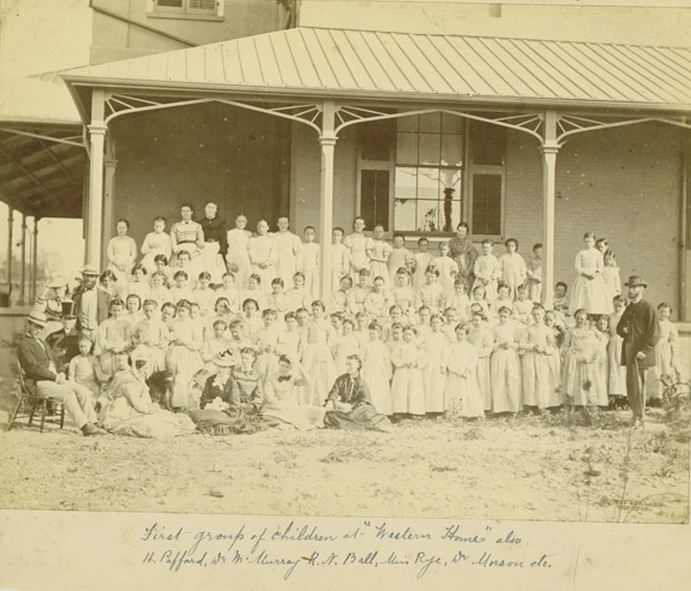
1869 Maria Rye
Maria Rye escorts first party of children to Canada. English social reformer Maria Rye founded the Female Middle Class Emigration Society in 1861 to transport young women to New Zealand, Australia and Canada. In 1869 she turns her attention to rescuing workhouse and orphan children and sending them to Canada. She escorts her first party of 76 children to her distributing home, 'Our Western Home', at Niagara-on-the-Lake, Ontario.
credit to the Niagara Historical Society & Museum
Maria Rye escorts first party of children to Canada. English social reformer Maria Rye founded the Female Middle Class Emigration Society in 1861 to transport young women to New Zealand, Australia and Canada. In 1869 she turns her attention to rescuing workhouse and orphan children and sending them to Canada. She escorts her first party of 76 children to her distributing home, 'Our Western Home', at Niagara-on-the-Lake, Ontario.
credit to the Niagara Historical Society & Museum
This is one of the Application Forms Maria Rye used for Farmer's wanting a child
Form to be filled up by Person in Canada applying for Children at “Our Western Home”, Niagara, Ontario
What is your full name?
Give me your full address.
Are you married?
Is your wife alive?
Have you any children, and how many?
What is your trade or profession?
How long have you lived in your present neighbourhood?
Do you belong to the Episcopal Church?
If not, state with what body of Christians you do worship?
Give me the name and address of the minister of the church where you worship.
Give me the name and address of the reeve or mayor of the town in which you live.
If I commit an orphan to your care, state what position she is to hold in your family.
Also state the age of the child you wish for.
Maria S Rye, Hon. Sec. Our Western Home, Niagara, Ontario, to whom this form is to be returned when filled up.
Form of Circular addressed by Miss Rye to the Reeve or Clergyman for information with regard to an Applicant for a Child. Our Western Home, Niagara.
Sir,.........
Mr and Mrs ........ having applied to me for one of the orphan girls under my care, and having given me your name as one of their references, please tell me, in confidence, whether you consider Mr & Mrs ...... and their family fit persons to have the charge of a little girl; and also how long you have known them. An early reply will oblige. Yours very faithfully, Maria S Rye
Form to be filled up by Person in Canada applying for Children at “Our Western Home”, Niagara, Ontario
What is your full name?
Give me your full address.
Are you married?
Is your wife alive?
Have you any children, and how many?
What is your trade or profession?
How long have you lived in your present neighbourhood?
Do you belong to the Episcopal Church?
If not, state with what body of Christians you do worship?
Give me the name and address of the minister of the church where you worship.
Give me the name and address of the reeve or mayor of the town in which you live.
If I commit an orphan to your care, state what position she is to hold in your family.
Also state the age of the child you wish for.
Maria S Rye, Hon. Sec. Our Western Home, Niagara, Ontario, to whom this form is to be returned when filled up.
Form of Circular addressed by Miss Rye to the Reeve or Clergyman for information with regard to an Applicant for a Child. Our Western Home, Niagara.
Sir,.........
Mr and Mrs ........ having applied to me for one of the orphan girls under my care, and having given me your name as one of their references, please tell me, in confidence, whether you consider Mr & Mrs ...... and their family fit persons to have the charge of a little girl; and also how long you have known them. An early reply will oblige. Yours very faithfully, Maria S Rye
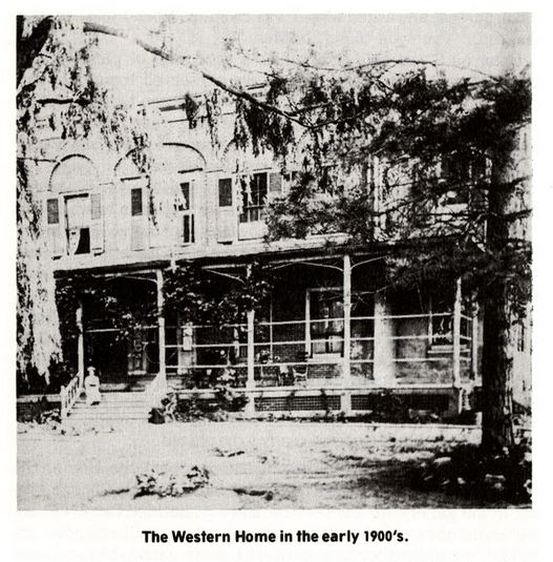
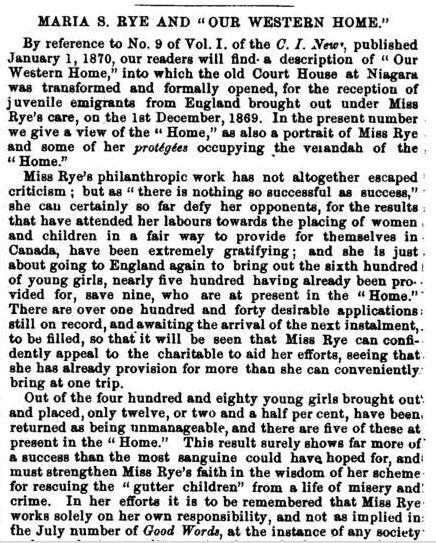
Canadian Illustrated News October 7 1871

Library and Archives Canada
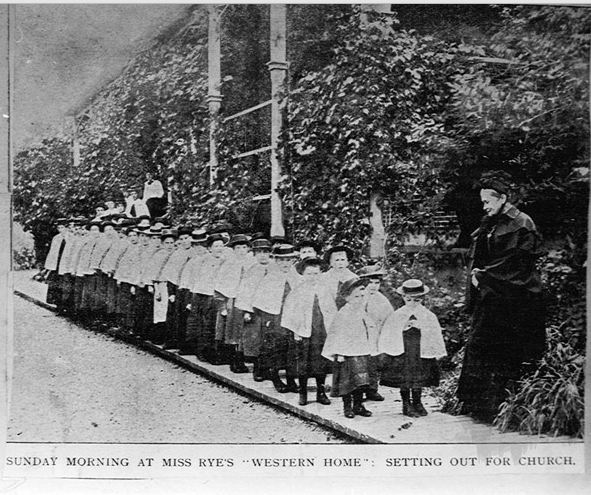
Niagara Historical Society & Museum
Some Maria Rye Children
Canadian Illustrated News Vol XI No 18 1 May 1875. Reproduced courtesy Library and Archives Canada
Canadian Illustrated News Vol XI No 18 1 May 1875. Reproduced courtesy Library and Archives Canada
"Peckham Home"
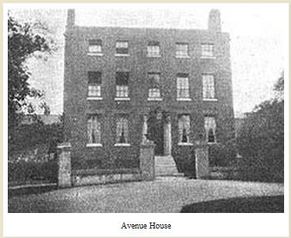
Avenue House, High Street,
Peckham, London
Children from Maria Rye's Peckham house were destined for immigration mainly to Canada
Avenue House, High Street,
Peckham, London
Children from Maria Rye's Peckham house were destined for immigration mainly to Canada
Maria Rye
Written by Joy Parr from Dictionary of Canadian Biography
RYE, MARIA SUSAN, social reformer; b. 31 March 1829 in London, England, daughter of Edward Rye, a solicitor, and Maria Tuppen; d. unmarried 12 Nov. 1903 in Hemel Hempstead, England.
Maria Susan Rye was a leading figure in the mid-19th-century women’s movement in England, serving from 1855 to 1858 as secretary of the association that promoted the Married Women’s Property Bill and from 1859 as a founding member of the Society for Promoting the Employment of Women. In these years she worked with and for women of her own class. Both in her business as a law stationer, where women were employed as legal copyists, and through related firms, where others were trained as compositors and telegraphists, she strove to break down the regulations and social conventions that kept middleclass women from gaining economic independence.
More socially conservative than her colleagues in the employment society, with whom she would part company over the issue of female suffrage, Rye became concerned about the social and moral effects of women’s more prominent role outside the home. Contemporaries linked the predicament of unmarried gentlewomen in Britain to the marriage-market imbalance created by the emigration of more men than women. Rye herself argued that both Britain and the colonies benefited when gentlemen abroad were not obliged to marry beneath them. Between 1861 and 1867, under the auspices of the Female Middle-Class Emigration Society, of which she was honorary secretary, Rye travelled with parties of adult women to the Australian colonies and New Zealand.
In 1868 rising costs and adverse Australian publicity caused her to consider ports nearer to Britain, in Canada. Criticism by newspapermen and public officials of the suitability, supervision, and placement of the 200 women she transported up the St Lawrence River later that year led Rye to shift her attention, beginning in 1869, to the rescue of poorhouse and orphaned children, the work for which she is best known in Canada. Between 1869 and 1896 her agency brought 3,623 female children to the dominion, a large proportion of them wards of the English poor-law unions which sponsored their emigration, and placed them from the reception centre Rye operated in a converted court-house and jail at Niagara (Niagara-on-the-Lake), Ont. Rye handled the financial affairs of the home and seems to have travelled to Canada most years, even as she became older.
Unlike Annie Macpherson, who also began bringing children to Canada in 1869, and the majority of other British agencies and individuals who together brought perhaps 80,000 girls and boys to Canada over the next 50 years, Rye did not identify with any evangelical Christian group. A devout but traditional Anglican, she kept aloof from low-church enthusiasms. She was foremost a social engineer. In her writing for the National Association for the Promotion of Social Science and in frequent letters to the London Times, she showed a brusque detachment from her young charges and a penchant for the expedient. These tendencies led the senior Canadian emigration agent in Britain, William Dixon*, to characterize her in November 1868 as a “passenger agent of the sharpest description.” In a famous broadsheet the following year, George Cruikshank, the illustrator of Dickens, caricatured her shovelling lilliputian youngsters, “like so much guano,” into a giant mud cart.
Of the 1,100 girls Rye brought to Canada before 1875, all but 200 were pauper wards of the British state, and she hoped that the Local Government Board would take over the program. This prospect was scotched in 1875 when Andrew Doyle, the board inspector deputed to inquire into the Canadian circumstances of former workhouse children, singled out her placement methods for criticism as unsystematic and inattentive. Yet over the next two decades, with only brief interruptions when the apprehensions of the English Board of Guardians about her work became acute, she regularly brought parties of girls to Canada, protected by a receptive public there and by the interventions of well-placed British allies, including Lord Shaftesbury and the Marquess of Lorne [Campbell*] and his wife, Princess Louise. From 1871 Rye received a civil-list pension of £70.
In 1895, by which time Ontario was beginning to examine the regulation of juvenile immigration [see John Joseph Kelso*], she transferred her distribution centres at Peckham (London) and Niagara to the Church of England Waifs and Strays Society, and retired with her sister to Hemel Hempstead. Maria S. Rye died of intestinal cancer in 1903 at their residence, Baconsthorpe.
Joy Parr
Documentation on the career of Maria Susan Rye is provided in the author’s study Labouring children: British immigrant apprentices to Canada, 1869–1924 (London and Montreal, 1980).
Two pamphlets published in Canada in defence of Rye’s emigration work have been made available on microfiche by the CIHM and are listed in its Reg.: Charges made against Miss Rye before the Poor Law Board at Islington, and her replythereto (n.p., [1874]) and Further letters furnished to the Department of Agriculture by Miss Rye, in rebuttal of Mr. Doyle’sreport ([Niagara (Niagara-on-the-Lake), Ont.?, 1875?]).
Andrew Doyle’s charges, and Rye’s response to them, were published in pamphlet form and in G.B., Parl., House of Commons papers, 1875, 63, no.9: 255–98, Copy “of a report to the right honourable the president of the Local GovernmentBoard, by Andrew Doyle, esquire, local government inspector, as to the emigration of pauper children to Canada”, esp. 277, 284, 286; and 1877, 71, no.392: 19–36, Copy “of letter addressed by Miss Rye to the president of the Local GovernmentBoard. . . .” Doyle refuted Rye’s defence in 1877, 71, no.263: 1–18, Copy “of the reply of Mr. Doyle to Miss Rye’s report. . . .”Canadian listings for the three reports are available in Canadiana, 1867–1900.
NA, RG 17, A I, 25, no.2252. Times (London), 22 April 1875. DNB. DNZB. Lee Holcombe, Victorian ladies at work:middle-class working women in England and Wales, 1850–1914 (Newton Abbot, Eng., 1973). Andrew Jones and Leonard Rutman, In the children’s aid: J. J. Kelso and child welfare in Ontario (Toronto, 1981). Ivy Pinchbeck and Margaret Hewitt,Children in English society (2v., London, [1969–73]). Gillian Wagner, Children of the empire (London, 1982).
Maria Susan Rye was a leading figure in the mid-19th-century women’s movement in England, serving from 1855 to 1858 as secretary of the association that promoted the Married Women’s Property Bill and from 1859 as a founding member of the Society for Promoting the Employment of Women. In these years she worked with and for women of her own class. Both in her business as a law stationer, where women were employed as legal copyists, and through related firms, where others were trained as compositors and telegraphists, she strove to break down the regulations and social conventions that kept middleclass women from gaining economic independence.
More socially conservative than her colleagues in the employment society, with whom she would part company over the issue of female suffrage, Rye became concerned about the social and moral effects of women’s more prominent role outside the home. Contemporaries linked the predicament of unmarried gentlewomen in Britain to the marriage-market imbalance created by the emigration of more men than women. Rye herself argued that both Britain and the colonies benefited when gentlemen abroad were not obliged to marry beneath them. Between 1861 and 1867, under the auspices of the Female Middle-Class Emigration Society, of which she was honorary secretary, Rye travelled with parties of adult women to the Australian colonies and New Zealand.
In 1868 rising costs and adverse Australian publicity caused her to consider ports nearer to Britain, in Canada. Criticism by newspapermen and public officials of the suitability, supervision, and placement of the 200 women she transported up the St Lawrence River later that year led Rye to shift her attention, beginning in 1869, to the rescue of poorhouse and orphaned children, the work for which she is best known in Canada. Between 1869 and 1896 her agency brought 3,623 female children to the dominion, a large proportion of them wards of the English poor-law unions which sponsored their emigration, and placed them from the reception centre Rye operated in a converted court-house and jail at Niagara (Niagara-on-the-Lake), Ont. Rye handled the financial affairs of the home and seems to have travelled to Canada most years, even as she became older.
Unlike Annie Macpherson, who also began bringing children to Canada in 1869, and the majority of other British agencies and individuals who together brought perhaps 80,000 girls and boys to Canada over the next 50 years, Rye did not identify with any evangelical Christian group. A devout but traditional Anglican, she kept aloof from low-church enthusiasms. She was foremost a social engineer. In her writing for the National Association for the Promotion of Social Science and in frequent letters to the London Times, she showed a brusque detachment from her young charges and a penchant for the expedient. These tendencies led the senior Canadian emigration agent in Britain, William Dixon*, to characterize her in November 1868 as a “passenger agent of the sharpest description.” In a famous broadsheet the following year, George Cruikshank, the illustrator of Dickens, caricatured her shovelling lilliputian youngsters, “like so much guano,” into a giant mud cart.
Of the 1,100 girls Rye brought to Canada before 1875, all but 200 were pauper wards of the British state, and she hoped that the Local Government Board would take over the program. This prospect was scotched in 1875 when Andrew Doyle, the board inspector deputed to inquire into the Canadian circumstances of former workhouse children, singled out her placement methods for criticism as unsystematic and inattentive. Yet over the next two decades, with only brief interruptions when the apprehensions of the English Board of Guardians about her work became acute, she regularly brought parties of girls to Canada, protected by a receptive public there and by the interventions of well-placed British allies, including Lord Shaftesbury and the Marquess of Lorne [Campbell*] and his wife, Princess Louise. From 1871 Rye received a civil-list pension of £70.
In 1895, by which time Ontario was beginning to examine the regulation of juvenile immigration [see John Joseph Kelso*], she transferred her distribution centres at Peckham (London) and Niagara to the Church of England Waifs and Strays Society, and retired with her sister to Hemel Hempstead. Maria S. Rye died of intestinal cancer in 1903 at their residence, Baconsthorpe.
Joy Parr
Documentation on the career of Maria Susan Rye is provided in the author’s study Labouring children: British immigrant apprentices to Canada, 1869–1924 (London and Montreal, 1980).
Two pamphlets published in Canada in defence of Rye’s emigration work have been made available on microfiche by the CIHM and are listed in its Reg.: Charges made against Miss Rye before the Poor Law Board at Islington, and her replythereto (n.p., [1874]) and Further letters furnished to the Department of Agriculture by Miss Rye, in rebuttal of Mr. Doyle’sreport ([Niagara (Niagara-on-the-Lake), Ont.?, 1875?]).
Andrew Doyle’s charges, and Rye’s response to them, were published in pamphlet form and in G.B., Parl., House of Commons papers, 1875, 63, no.9: 255–98, Copy “of a report to the right honourable the president of the Local GovernmentBoard, by Andrew Doyle, esquire, local government inspector, as to the emigration of pauper children to Canada”, esp. 277, 284, 286; and 1877, 71, no.392: 19–36, Copy “of letter addressed by Miss Rye to the president of the Local GovernmentBoard. . . .” Doyle refuted Rye’s defence in 1877, 71, no.263: 1–18, Copy “of the reply of Mr. Doyle to Miss Rye’s report. . . .”Canadian listings for the three reports are available in Canadiana, 1867–1900.
NA, RG 17, A I, 25, no.2252. Times (London), 22 April 1875. DNB. DNZB. Lee Holcombe, Victorian ladies at work:middle-class working women in England and Wales, 1850–1914 (Newton Abbot, Eng., 1973). Andrew Jones and Leonard Rutman, In the children’s aid: J. J. Kelso and child welfare in Ontario (Toronto, 1981). Ivy Pinchbeck and Margaret Hewitt,Children in English society (2v., London, [1969–73]). Gillian Wagner, Children of the empire (London, 1982).
Questions on the forms when applying for a child from Our Western Home
What is your full name?
Give me your full address.
Are you married?
Is your wife alive?
Have you any children, and how many?
What is your trade or profession?
How long have you lived in your present neighbourhood?
Do you belong to the Episcopal Church?
If not, state with what body of Christians you do worship?
Give me the name and address of the minister of the church where you worship.
Give me the name and address of the reeve or mayor of the town in which you
live.
If I commit an orphan to your care, state what position she is to hold in
your family.
Also state the age of the child you wish for.
Maria S Rye, Hon. Sec. Our Western Home, Niagara, Ontario, to whom this
form is to be returned when filled up.
*********************
Form of Circular addressed by Miss Rye to the Reeve or Clergyman for
information with regard to an Applicant for a Child. Our Western Home,
Niagara.
Sir,.........
Mr and Mrs ........ having applied to me for one of the orphan girls under
my care, and having given me your name as one of their references, please
tell me, in confidence, whether you consider Mr & Mrs ...... and their
family fit persons to have the charge of a little girl; and also how long
you have known them. An early reply will oblige. Yours very faithfully,
Maria S Rye
Source: Gail Collins Roots Web
What is your full name?
Give me your full address.
Are you married?
Is your wife alive?
Have you any children, and how many?
What is your trade or profession?
How long have you lived in your present neighbourhood?
Do you belong to the Episcopal Church?
If not, state with what body of Christians you do worship?
Give me the name and address of the minister of the church where you worship.
Give me the name and address of the reeve or mayor of the town in which you
live.
If I commit an orphan to your care, state what position she is to hold in
your family.
Also state the age of the child you wish for.
Maria S Rye, Hon. Sec. Our Western Home, Niagara, Ontario, to whom this
form is to be returned when filled up.
*********************
Form of Circular addressed by Miss Rye to the Reeve or Clergyman for
information with regard to an Applicant for a Child. Our Western Home,
Niagara.
Sir,.........
Mr and Mrs ........ having applied to me for one of the orphan girls under
my care, and having given me your name as one of their references, please
tell me, in confidence, whether you consider Mr & Mrs ...... and their
family fit persons to have the charge of a little girl; and also how long
you have known them. An early reply will oblige. Yours very faithfully,
Maria S Rye
Source: Gail Collins Roots Web
Ship Arrival Announcements
source: Gail Collins
Many of the Ship arrivals were announced in newspapers.
This is another Resource that could be checked for added information regarding your BHC.
Below is a sample of articles for the Nestorian arriving 1871 with Maria Rye orphans.
SS Nestorian 1871 Oct 24 - Nov 10 LAC Film C-4527 to Quebec Ship # on the film
No ship manifests to Halifax prior to 1881
Morning Chronicle (Halifax) 6 Nov 1871 (Arrived Halifax 5 Nov 1871)
MISS RYE'S ORPHANS - Among the passengers from E ngland by the steamer "Nestorian" which arrived yesterday morning, were 145 orphan girls, of ages from 9 to 13 years, in charge of Miss Maria S. Rye, an English lady who has for several years been showing her practical philanthropy by finding comfortable homes in the Provinces for English orphan children. Miss Rye and 36 of the little ones, who were to remain in Halifax, took quarters at the International Hotel. Arrangements had previously been made by Mr. W. G. Pedley, of the Employment Officer, for the adoption or employment of the children in families of known respectability - a matter in which Miss Rye is particularly careful - and the little ones were soon taken away to their new homes. About 60 were sent on by railway to St. John, and the remainder will proceed in the "Nestorian" to Quebec and Montreal.
Montreal Gazette, November 11, 1871The steamship Nestorian, Captain Aird, from Liverpool via Halifax, arrived in port this morning. When off the Pillars [island lighthouse in the St. Lawrence], she collided with an unknown vessel outward bound causing considerable injury to the steamer. A tug boat has gone in search of the unknown vessel to render assistance if needed. Montreal Gazette, November 13, noted that the bark, Arthur, from Quebec for Sunderland with lumber had returned with minor damage from the collision.Ontario Agent's Report at QuebecNovember 10, 1871 Nestorian - This steamer brought out a party of girls under charge of one of Miss Rye's matrons. They were granted free passes to Toronto. Miss Rye and 80 children remained in the Lower Province. Miss Rye's girls of a much superior class to those brought out in SS Prussian on the 7th of August last.
1871 report by Mr. Shives for Saint John, New Brunswickdated 17 January 1872 he writes: `In November last, Miss Rye brought to St.John, eleven adults and forty-one children. They were eagerly taken up, and all were placed in comfortable homes. They came out to Halifax in the SS Nestorian, of the Allan Line, and thence were conveyed by rail and steamer to this city.'
THE TRUNK - What's in the Trunk?
THE TRUNK - in 1873 the cost to send a child to Canada through Maria Rye was £8 with the outfit costing £2 or £2 10s.,
& free delivery at Liverpool. In Annual Reports which listed the Annual Subscriptions and Donors by name, Rye asked for volunteer workers and children's clothes, both old and new. Included in her annual Balance Sheets were costs for clothes bought and making of, Sundries, and Boxes. Acknowledgement of parcels of clothing, both old and new, and much help with needlework, have been gratefully received during the past year from......
Detailed below is "Little Girls Outfit for Canada 1894"
Transcribed by Chris Sanham
Maria Rye Co-oridinators
Gail Collins 1868 - 1879 [email protected]
Chris Sanahm 1880 - 1896 [email protected]
"Little Girls Outfit for Canada 1894"
£ : s : d
3 pairs of drawers 1 : 6
3 night gowns 4 : 0
3 chemises 2 : 0
2 cotton petticoats with tops 1 : 4
2 flannel petticoats with tops 3 : 0
3 pairs cotton stockings 2 : 0
3 pairs warm stockings 3 : 0
2 cotton frocks 4 : 0
2 Lindsey (?) frocks 6 : 0
2 warm petticoats 4 : 0
1 warm brown Ulster * 11 : 0
3 pinafores or aprons 1 : 0
1 straw hat for Sunday 3 : 6
1 straw hat for travel in 1 : 6
2 pairs of boots 11 : 0
3 pocket handkerchiefs 1: 0
1 brush & comb & bag 2: 0
1 bible & prayer book 2: 0
1 box - addressed 6: 0
Canvas bag 1: 0
Total £3 :10s :10d
* dictionary defines an Ulster as "A long loose rough overcoat, often with a waist belt"
& free delivery at Liverpool. In Annual Reports which listed the Annual Subscriptions and Donors by name, Rye asked for volunteer workers and children's clothes, both old and new. Included in her annual Balance Sheets were costs for clothes bought and making of, Sundries, and Boxes. Acknowledgement of parcels of clothing, both old and new, and much help with needlework, have been gratefully received during the past year from......
Detailed below is "Little Girls Outfit for Canada 1894"
Transcribed by Chris Sanham
Maria Rye Co-oridinators
Gail Collins 1868 - 1879 [email protected]
Chris Sanahm 1880 - 1896 [email protected]
"Little Girls Outfit for Canada 1894"
£ : s : d
3 pairs of drawers 1 : 6
3 night gowns 4 : 0
3 chemises 2 : 0
2 cotton petticoats with tops 1 : 4
2 flannel petticoats with tops 3 : 0
3 pairs cotton stockings 2 : 0
3 pairs warm stockings 3 : 0
2 cotton frocks 4 : 0
2 Lindsey (?) frocks 6 : 0
2 warm petticoats 4 : 0
1 warm brown Ulster * 11 : 0
3 pinafores or aprons 1 : 0
1 straw hat for Sunday 3 : 6
1 straw hat for travel in 1 : 6
2 pairs of boots 11 : 0
3 pocket handkerchiefs 1: 0
1 brush & comb & bag 2: 0
1 bible & prayer book 2: 0
1 box - addressed 6: 0
Canvas bag 1: 0
Total £3 :10s :10d
* dictionary defines an Ulster as "A long loose rough overcoat, often with a waist belt"
Listed on the 1891 census of Canada as at the Maria Rye house:
Edith L Jones, Rose E Nudd, Bertha Brown, Emma Bennett, Ellen Nicholson, Jane O'Callaghan, Elizabeth Holden, Hannah R Frost, Julia Westgate, Georgina Street, Lizzie M Grimes, Kate Fuller, Hettie L Inzo, Ellen Bowhay, Ellen Bowhay, Ada A Smith, Beatrice Brown, Esther M Keep, Elizabeth Herwig, Ellen Pelley, Lilian B Horwood, Elizabeth Humphrey, Jane Blair, Ethel M Harwood, Ellen Haines, Florence Morris or Norris, Mary Aldons, Rose Peach, Ellen Oram, Lucy Hardwick, Caroline Ellis, Gertrude Pelley, Eliza Harvey, Earnest Bissell, Harriet A Heath
Edith L Jones, Rose E Nudd, Bertha Brown, Emma Bennett, Ellen Nicholson, Jane O'Callaghan, Elizabeth Holden, Hannah R Frost, Julia Westgate, Georgina Street, Lizzie M Grimes, Kate Fuller, Hettie L Inzo, Ellen Bowhay, Ellen Bowhay, Ada A Smith, Beatrice Brown, Esther M Keep, Elizabeth Herwig, Ellen Pelley, Lilian B Horwood, Elizabeth Humphrey, Jane Blair, Ethel M Harwood, Ellen Haines, Florence Morris or Norris, Mary Aldons, Rose Peach, Ellen Oram, Lucy Hardwick, Caroline Ellis, Gertrude Pelley, Eliza Harvey, Earnest Bissell, Harriet A Heath
The Rye Plot in St. Marks Anglican Church Cemetery,
Niagara-on-the-Lake, Ontario, Canada.
photos courtesy of tallow65 on Flicker
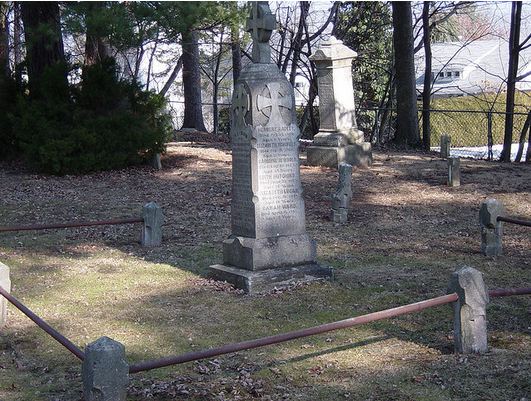
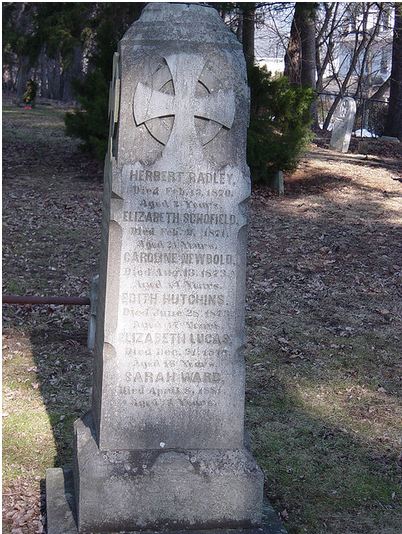
Buried in the Rye Plot are:
DAVIS, Mary, 16 (died October 12, 1884);
KAREY, Ethel, 11 (died June 6, 1888);
FERRIS, Ada, 15 (died June 16, 1885;
BAYLEY, Emily, 75 (died December 14,1922),Matron, Western Home;
RADLEY, Herbert, 2, (died February 13, 1870);
SCHOFIELD, Elizabeth, 21 (died February 2, 1871);
NEWBOLD, Caroline, 14 (died August 18, 1873);
HUTCHINS, Edith, 17 (died June 28, 1873);
LUCAS, Elizabeth, 16 (died December 21, 1874);
WARD, Sarah, 12 (died April 8, 1881);
PORTER, (only the name here and no stone).
DAVIS, Mary, 16 (died October 12, 1884);
KAREY, Ethel, 11 (died June 6, 1888);
FERRIS, Ada, 15 (died June 16, 1885;
BAYLEY, Emily, 75 (died December 14,1922),Matron, Western Home;
RADLEY, Herbert, 2, (died February 13, 1870);
SCHOFIELD, Elizabeth, 21 (died February 2, 1871);
NEWBOLD, Caroline, 14 (died August 18, 1873);
HUTCHINS, Edith, 17 (died June 28, 1873);
LUCAS, Elizabeth, 16 (died December 21, 1874);
WARD, Sarah, 12 (died April 8, 1881);
PORTER, (only the name here and no stone).
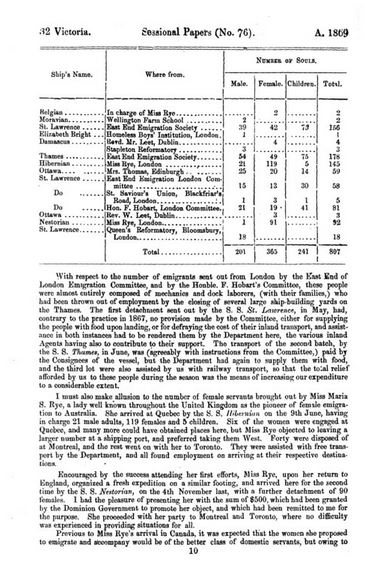
Sessional papers of the Dominion of Canada


St. Catharine's Public Library
Special Collections
St. Catharines Public Library
54 Church Street
St. Catharines, ON
L2R 7K2
(905) 688 6103 EXT 220.
Non-summer hours are 10-9 Tuesday, Wednesday, Thursday,10-6 Friday and 9-5 Saturdays. Closed Monday.
Special Collections on Home Children include information on the Maria Rye home on Niagara-on-the-Lake; the most popular books on the topic (these are circulating books); and immigrant children passenger lists from the NAC. These are not available for loan and are on 4 reels of microfilm. (Thanks to Gail Benjafield, SPCOLL Librarian for this information.)
Source - http://www.genealogic.co.uk
Links
SARMATIAN SHIPMATES
DEDICATED TO THE BRITISH HOME CHILDREN
WHO SAILED WITH THE MARIA RYE PARTY
ABOARD THE SARMATIAN IN JUNE OF 1874
Historical Maria Rye Manuscripts
The Western Plot by Gail Collins
Letters from Maria Rye Children
List of Maria Rye early children
Maria Rye 1874 Children
Inspection reports of some Maria Rye children held by the Ontario archives
Special Collections
St. Catharines Public Library
54 Church Street
St. Catharines, ON
L2R 7K2
(905) 688 6103 EXT 220.
Non-summer hours are 10-9 Tuesday, Wednesday, Thursday,10-6 Friday and 9-5 Saturdays. Closed Monday.
Special Collections on Home Children include information on the Maria Rye home on Niagara-on-the-Lake; the most popular books on the topic (these are circulating books); and immigrant children passenger lists from the NAC. These are not available for loan and are on 4 reels of microfilm. (Thanks to Gail Benjafield, SPCOLL Librarian for this information.)
Source - http://www.genealogic.co.uk
Links
SARMATIAN SHIPMATES
DEDICATED TO THE BRITISH HOME CHILDREN
WHO SAILED WITH THE MARIA RYE PARTY
ABOARD THE SARMATIAN IN JUNE OF 1874
Historical Maria Rye Manuscripts
The Western Plot by Gail Collins
Letters from Maria Rye Children
List of Maria Rye early children
Maria Rye 1874 Children
Inspection reports of some Maria Rye children held by the Ontario archives